You know the sweater that I'm talking about. You may even have one in your closet. You may not even think it's ugly. You aren't the only one!
I will concede to the fact that there are a lot of Ugly Christmas Sweaters around, but I never owned one. Never owned an ugly one, that is.
I have owned and worn Christmas Sweaters since before they were referred to as ugly and long before there was an Ugly Christmas Sweater Day.
Christmas Sweaters are fun. They are happy sweaters. They brighten the day of those who wear them. They bring a smile to everyone else.
Ugly Christmas Sweater Day was first celebrated in 2011 and it has become a fund raiser for children's charities. Ugly Christmas Sweater Day falls on the third Friday of December each year and is celebrated internationally. Are you ready to join the celebration?
Reach into your closet and pull out that Christmas Sweater. You know it's in there somewhere.
Be bold. Be brave. Be the person who wears a Christmas Sweater any day in December.
Let's take the "ugly" out of Christmas Sweaters and truly appreciate them for the love and joy they bring to you, and to you, your wassail, too, and may God bless you and send you a Happy New Year!
🔍To return to the main page, please click on the banner at the top of this page or click on this link: Cupola Corner Blog
Check out my wassail recipe here: Wassail
Showing posts with label Family Fun. Show all posts
Thursday, December 13, 2018
Thursday, November 22, 2018
Lemon Tree: Believe. Hope. Drink Lemonade.
Winter has not yet officially begun. As I look out the window at the snow, however, I am experiencing garden withdrawal. After considering a variety of indoor gardening projects that require more space than I have available, I have settled on a project. I am going to plant lemon seeds and grow a lemon tree.
They say that gardening is a way of showing that you believe in tomorrow. Well, from what I’ve been reading about lemon trees, it would appear that I will need a lot of tomorrows before I can make lemonade.
Apparently, lemon seeds germinate within a few weeks. That will mean sprouts before Christmas. That’s exciting! Lemons, however, could be several years down the road. I believe in tomorrow.
There are lots of things that you can grow indoors, but right now one lemon and one small pot of soil seem to be just the thing to ward off garden withdrawal. It really does seem like a hopeful project and hope is good.
Believe. Hope. Drink lemonade.
Sounds perfect. Why not give it a try?
🔍To return to the main page, please click on the banner at the top of this page or click on this link: Cupola Corner Blog
Sunday, June 24, 2018
Podcast: Spa Day For The Alpacas (Black Ash Acres)
Listen at SoundCloud OR on iTunes.
🔍To return to the main page, please click on the banner at the top of this page or click on this link: Cupola Corner Blog
Friday, June 15, 2018
Podcast: Strawberry Fields
Listen at SoundCloud OR on iTunes.
🔍To return to the main page, please click on the banner at the top of this page or click on this link: Cupola Corner Blog
Tuesday, May 15, 2018
Lemonade Stand: Homemade Lemonade 5¢
There's just something about homemade lemonade that sets it apart from frozen concentrate. Yes, you have to juice the lemons (or not!) and yes, it takes a little longer than opening a can. But, it tastes amazing! What better way to celebrate the upcoming first long weekend of summer than with a jug of ice cold homemade lemonade.
I have lots of great memories of selling lemonade with my sister at our make-shift lemonade stand. We never made a lot of money, but it was the beginning of the entrepreneurial spirit in both of us. Such fun!
My daugher set up a lemonade stand one summer day when she was quite young and sold lemonade to the thirsty tennis players in the park behind our house. Location, location, location.
My recipe makes 3 1/2 cups. Double the recipe (see italics) if you are expecting company. Little helpers can get involved with juicing the lemons, but keep those young ones away from the stove and the sugar syrup. I once got second degree burns from making homemade lemonade. The syrup got on me when I was pouring it from the saucepan. Yikes!
I hope that you enjoy your Homemade Lemonade. Please feel free to share this recipe with your friends and family.
Homemade Lemonade
(Double Recipe in Italics)
Ingredients:
3 lemons, or 1/2 cup
lemon juice (6 lemons/1
cup lemon juice)
1/2 cup white sugar (1 cup)
3 cups water (6 cups)
Lemon slices for garnish
Directions:
- In a sauce pan mix the sugar into 1 cup (2 cups) of the water. Heat until sugar has dissolved. Chill.
- Juice the lemons to make 1/2 cup (1 cup) of juice. Roll the lemons on a hard surface with the heel of your hand before you cut into them and they will juice more easily. Skip this step if you are using lemon juice from a bottle. Juice all of the lemons and adjust the amount of water if you have more juice than the amount listed.
- In a pitcher, combine the chilled sugar syrup, the lemon juice and the remaining 2 cups (4 cups) of water. Chill and serve over ice. Garnish with a slice of lemon. Enjoy!
Makes 3 1/2 cups (7
cups)
Single Serving (1/2 cup): 58
calories; 14.5 g. carbohydrates; .1 g. dietary fibre
🔍To return to the main page, please click on the banner at the top of this page or click on this link: Cupola Corner Blog
Sunday, April 15, 2018
Marvelous Mud
As I was mucking about in the garden, wearing my new wellies, I started thinking about mud. Slippery, sloppy, marvelous mud. This time of year, it seems that mud is everywhere, not just in the garden. And by everywhere, I mean to include my kitchen floor.
When you think about it, mud really is just about everywhere, with the exception, perhaps, of the North and South Poles. Mud is what you get when you mix dirt and water. If you’ve got both of these things, mud is inevitable.
With mud being so plentiful, it’s no wonder that it gets used for everything from adobe to art work. Mud has been a part of the human condition forever. It’s also a resource that we share with all living things.
Prehistoric people left evidence of their existence in mud. Human footprints recently found in Tanzania are estimated to be between 5,000 to 19,000 years old. In Tennessee, cavers found ancient drawings in mud on the walls of what is now known as Mud Glyph Cave.
Mud is still used in artistic ways today. Japanese artist Yusuke Asai creates incredible murals using mud. Some artists use dirt to colour their paints...mud paints. Pottery is made from clay, a form of mud. Kids create art in mud and with mud every time it rains or when the sprinkler gets left on too long.
Mud is not just for aesthetics. People have used mud in construction since prehistoric times. Mud bricks, called adobe, are air dried in molds. Straw is sometimes added to the mud mixture to provide additional stability to the finished bricks. Fired bricks are sometimes made from clay, a form of mud. Banco or ferey is a type of brick made with mud and grain husks. The Great Mosque of Djenne in Mali is a Unesco World Heritage Site that is made from banco bricks. Mud is also used like plaster to cover walls. Mudcrete, a blend of mud and concrete, is sometimes used to build roads.
Mud is also used for recreational purposes. Mudding is a popular Motorsport activity and runners can participate in mud runs. There’s also mud wrestling for those so inclined.
How about a mud bath? Pelotherapy, or the therapeutic use of mud, has been used for thousands of years as a way to relieve arthritic pain. Some mud bathers actually lie in a tub of mud. Others smear the mud all over their bodies. I don't think that I could sit in a tub of mud, but rubbing mud on my sore knees or soaking my tired feet in mud sounds like something I just might like to try. If you travel, you might run across one of the mud baths recommended by American Express.
You don't have to go far to enjoy a mud mask. You can find prepared mud masks in the cosmetic section of many department stores or you can mix up something at home from a package. If you are the adventurous type, you could even give a made from scratch recipe a try. Your face will feel clean, smooth and rejuvenated.
You have probably heard at least one of the many versions of the jazz tune "Mississippi Mud" or perhaps Brad Paisley's "Mud on the Tires". And then, of course, there was McKinley Morganfield, better known as Muddy Waters, the blues musician often referred to as the father of modern Chicago blues. Mud is in the title or lyrics of many popular songs.
Mud has made its way into our daily conversations in the form of figurative language. That’s as clear as mud. Here’s mud in your eye. Don’t be a stick in the mud. My name is mud. As happy as a pig in mud.
Pigs are not the only animals that like or use mud. Just like people, some animals, like birds and wasps, use mud to build their homes. Animals that wallow in mud, like pigs and elephants, do so, in part, because it’s a comfort behaviour that contributes to their wellbeing. Sounds like a visit to the spa to me.
It turns out that mud pies aren't just for playtime. Geophagia is the practice of eating mud or clay. While it sometimes has psychiatric implications, it is not uncommon for people who are living in poverty to eat dirt or mud. Some forms of clay, such as bentonite or kaolin are also used as digestive aids or as the base for some medicines. There are, however, risks associated with eating dirt or mud and it is generally not considered a safe practice. That being said, I highly recommend a large slice of Mississippi Mud pie. Consuming Mississippi Mud pie would not be considered a form of geophagia. Check out one of these awesome recipes at Epicurious or The Food Network.
Since 2009 we have been able to celebrate Marvelous Mud with International Mud Day. This year's celebration takes place June 29th. If you're interested in celebrating, check out some of the suggested activities at Kodo Kids or Artful Adventures. Or maybe you could just enjoy a mud mask. Either way, don't be a stick in the mud. Take some time to enjoy Marvelous Mud. Here's mud in your eye!
🔍To return to the main page, please click on the banner at the top of this page or click on this link: Cupola Corner Blog
When you think about it, mud really is just about everywhere, with the exception, perhaps, of the North and South Poles. Mud is what you get when you mix dirt and water. If you’ve got both of these things, mud is inevitable.
With mud being so plentiful, it’s no wonder that it gets used for everything from adobe to art work. Mud has been a part of the human condition forever. It’s also a resource that we share with all living things.
Mud is still used in artistic ways today. Japanese artist Yusuke Asai creates incredible murals using mud. Some artists use dirt to colour their paints...mud paints. Pottery is made from clay, a form of mud. Kids create art in mud and with mud every time it rains or when the sprinkler gets left on too long.
Mud is not just for aesthetics. People have used mud in construction since prehistoric times. Mud bricks, called adobe, are air dried in molds. Straw is sometimes added to the mud mixture to provide additional stability to the finished bricks. Fired bricks are sometimes made from clay, a form of mud. Banco or ferey is a type of brick made with mud and grain husks. The Great Mosque of Djenne in Mali is a Unesco World Heritage Site that is made from banco bricks. Mud is also used like plaster to cover walls. Mudcrete, a blend of mud and concrete, is sometimes used to build roads.
Mud is also used for recreational purposes. Mudding is a popular Motorsport activity and runners can participate in mud runs. There’s also mud wrestling for those so inclined.
How about a mud bath? Pelotherapy, or the therapeutic use of mud, has been used for thousands of years as a way to relieve arthritic pain. Some mud bathers actually lie in a tub of mud. Others smear the mud all over their bodies. I don't think that I could sit in a tub of mud, but rubbing mud on my sore knees or soaking my tired feet in mud sounds like something I just might like to try. If you travel, you might run across one of the mud baths recommended by American Express.
You don't have to go far to enjoy a mud mask. You can find prepared mud masks in the cosmetic section of many department stores or you can mix up something at home from a package. If you are the adventurous type, you could even give a made from scratch recipe a try. Your face will feel clean, smooth and rejuvenated.
You have probably heard at least one of the many versions of the jazz tune "Mississippi Mud" or perhaps Brad Paisley's "Mud on the Tires". And then, of course, there was McKinley Morganfield, better known as Muddy Waters, the blues musician often referred to as the father of modern Chicago blues. Mud is in the title or lyrics of many popular songs.
Mud has made its way into our daily conversations in the form of figurative language. That’s as clear as mud. Here’s mud in your eye. Don’t be a stick in the mud. My name is mud. As happy as a pig in mud.
Pigs are not the only animals that like or use mud. Just like people, some animals, like birds and wasps, use mud to build their homes. Animals that wallow in mud, like pigs and elephants, do so, in part, because it’s a comfort behaviour that contributes to their wellbeing. Sounds like a visit to the spa to me.
Since 2009 we have been able to celebrate Marvelous Mud with International Mud Day. This year's celebration takes place June 29th. If you're interested in celebrating, check out some of the suggested activities at Kodo Kids or Artful Adventures. Or maybe you could just enjoy a mud mask. Either way, don't be a stick in the mud. Take some time to enjoy Marvelous Mud. Here's mud in your eye!
🔍To return to the main page, please click on the banner at the top of this page or click on this link: Cupola Corner Blog
References:
- 11 Benefits of Mud Baths [Photograph found in Baths at Roman Spa, California]. (n.d.). Retrieved February 7, 2018, from http://bathsromanspa.com/10-benefits-of-mud-baths/
- Horned Owl - Mud Glyph Cave [Photograph found in Atlanta]. (n.d.). Retrieved February 7, 2018, from https://www.cnn.com/2013/06/20/us/tennessee-cave-art/index.html
- Muddy Boots [Photograph found in She Knows]. (n.d.). Retrieved February 13, 2018, from http://www.sheknows.com/home-and-gardening/articles/972515/update-your-mudroom-for-fall
- Mud Pie [Photograph found in Food Network]. (n.d.). Retrieved February 13, 2018, from https://www.foodnetwork.com/recipes/food-network-kitchen/mississippi-mud-pie-recipe-2043369
- O'Keefe, M. T. (n.d.). What Is Adobe? [Photograph found in Photographer's Choice RF Collection, ThoughtCo]. Retrieved February 7, 2018, from https://www.thoughtco.com/what-is-adobe-sustainable-energy-efficient-177943
- Yamatane by Yusuke Asai [Photograph found in Rice Gallery, Houston, Texas]. (n.d.). Retrieved February 7, 2018, from http://www.ricegallery.org/yusuke-asai/
Sunday, April 01, 2018
Easter, Eggs & Shaving Cream
Easter eggs have been around a long time. They were a part of spring festivals and celebrations long before there was Easter. Eggs symbolize new life. They were a natural fit for Christian beliefs and were easily assimilated into Easter traditions. Even coloured or decorated eggs predate Easter. Decorated ostrich egg shells, that were found in Africa, are over 60,000 years old.
Egg decorating in the Christian tradition began with eggs that were stained red to symbolize the blood of Christ. Over time, egg decorating took on many different looks, some of which continue today. Decorations often held symbolic meanings related to Easter or spring. Ukrainian Pysanka are perhaps the most well known decorated eggs. These amazingly beautiful eggs are decorated using a wax resist (batik) method.
When my daughter was about eight years old, my mother and I took her to a Ukrainian egg making workshop at a local art gallery. We have no Ukrainian family connections, but lots of curiosity and we learned the basics in an evening. That being said, I can assure you that it would take years of practice to be able to create the eggs that you see in pictures.
Over the years, as egg traditions continued, chocolate eggs made their debut in Europe in the mid 1800s. The popularity of chocolate eggs has grown steadily and today millions of chocolate eggs are consumed every year.
This year, I wanted to make some decorated Easter eggs to help give the house a spring look. I decided to try making some shaving cream Easter eggs. It was lots of fun and I’m pleased with the results. The marbled look is lovely and each egg is one of a kind. The directions were easy to follow. Shaving cream Easter eggs could be made with children, under supervision. The instructions include information about how to make the eggs using whipped cream so that they can be eaten.
Whether you celebrate Easter or not, I wish for you a lovely spring day and hope that you have the opportunity to spend some time with family and friends on this holiday weekend. And, of course, I hope that you are enjoying some Easter eggs of your own.
🔍To return to the main page, please click on the banner at the top of this page or click on this link: Cupola Corner Blog
Sunday, March 18, 2018
Let’s Go Fly a Kite
Have you ever flown a kite? I have lots of good memories of making and flying kites in my younger years. My Dad was somewhat of a kite connoisseur and taught us the basics of construction and flight. I mostly remember keep it light, make it strong, use a bridle and a tail. From newspaper kites to ones made with plastic garbage bags, we got a lot of strange looking things to fly. It was lots of fun.
Kites were invented in China in the 5th century B.C. They were used for a variety of recreational, scientific and military purposes. Some of these early kites could lift men off the ground and some made music as they flew. From China, kite making made its way east through Asia. Although stories of kites made their way to Europe through Marco Polo in the 13th century, it wasn’t until the 16th and 17th centuries that kites appeared in Europe.
Kite flying and kite festivals are very popular throughout Asia and parts of Europe and South America. Some of these festivals take the form of kite fighting, others are contests and many are a form of celebration. In Bermuda, kites are flown on Good Friday to celebrate the resurrection of Christ.
For many years my sister’s family had a kite tradition where they took a small compact kite with them whenever they travelled. They would fly the same kite in the different locations that they visited.
I still love to fly kites. Kite flying can be a fun activity for all ages. Once you get your kite in the air, it can be a very relaxing, enjoyable experience. If you think that you’d like to give kite flying a try, you can buy a kite at a hobby or toy store, or you could order one online. If you’re up to the challenge, you could even try making your own kite.
There are safety considerations when flying a kite. A large open area with no above ground electrical power lines is essential. Your kite could become a dangerous electrical conductor. A space without a lot of trees will ensure that your kite is not “eaten” by a tree, a fate that Charlie Brown often experienced. If you think that you’d like to fly a really big kite, be aware that large kites often lift people off the ground or drag them along, causing injuries. If you live in an urban area, there may be kite flying height restrictions to ensure the safety of low flying aircraft.
Even if you aren’t up to actually flying a kite, just watching a kite in flight can also be an enjoyable experience. Although kite festivals are not so popular in North America, there are still lots of kite enthusiasts around. Keep an eye on the local media for planned events. You might even get lucky and just happen upon a kite in flight on a spring excursion.
The next time that someone tells you to “go fly a kite”, take them up on the suggestion. In fact, why not invite them to join you. A second person is always helpful when getting a kite airborne. You’ll both enjoy the experience.
“Let’s go fly a kite, Up to the highest height!” (from the movie, Mary Poppins)
🔍To return to the main page, please click on the banner at the top of this page or click on this link: Cupola Corner Blog
Sunday, March 04, 2018
Maple Magic
Sugar maple trees grow in the hardwood forests of the central area of eastern North America. If you live in this area, you have probably made a trip to a sugar bush at some point in your life. You may even have a sugar maple or two growing right in your neighborhood.
Maple syrup is made from the sap of the sugar maple tree. It is collected in the spring, boiled down, packaged and then enjoyed by millions of people around the world.
Maple sap can only be collected in the spring. Indigenous people called this time the maple moon. The cold nights and warming days cause the sap to move up and down the trunk. This movement is what makes it possible to collect the sap. The freezing and thawing of the sap builds up pressure forcing it to flow out through the tap holes.
Maple sap was first collected by indigenous people using hand carved spouts which were inserted into a cut through the outer layers of bark. The sap was collected in bowls made from birch bark. Later, spiles, or metal spouts were used. As the sap dripped from the tree, it was collected in wooden or metal pails. Today, commercial locations use a system of hoses that run from tree to tree and the sap is moved using a vacuum pump to a central location.
Once the sap has been collected, it is boiled until it becomes thick. The ratio of sap to syrup is 40:1. Forty litres of sap must be boiled down to make one litre of syrup. Indigenous people put the sap into a hollowed out log and then put hot rocks into the sap to boil off the water. Later, people filled large vats or kettles with sap and placed it over a hot wood fire. This method is still used today, but commercial operations use large tanks in a sugarhouse and the heat source is often oil, instead of wood.
Commercially produced maple syrup is then graded for color and taste before it is packaged. The darker the syrup, the stronger the flavor. Maple syrup is usually packaged in glass bottles. Sometimes it is sold in metal cans or plastic bottles.
My husband's father had a sugar bush on his farm in the Muskokas. One year he bought some maple sap collecting supplies at a yard sale and decided that he would make maple syrup. He collected the buckets of sap by hand and boiled the sap in a large kettle over a roaring fire. He underestimated how long it would take to boil down the sap and ended up having to sleep overnight in the bush in order to keep an eye on the syrup and the fire. He ended up with several gallons of delicious syrup, but that was the one and only time that he made maple syrup.
Maple syrup is delicious on pancakes, waffles, hot cereal or ice cream. It is used as a sweetener in a wide range of beverages and foods. Try some instead of sugar the next time that you make applesauce...yum!
Buzz Feed has a list of recipe ideas for using maple syrup that they've collected. You can find their list here: "57 Magical Ways to Use Maple Syrup" You can also scroll through the Food Network's maple syrup recipes here: "50 Sweet and Savoury Maple Syrup Recipes"
Here are links to some of my favourite maple flavored recipes:
If you live in an area where maple syrup is made, there are lots of opportunities this time of year to attend a Maple Syrup Festival. It's a great opportunity to see the sugar bush and learn about the process of making maple syrup. You may also get the chance to try some samples! Some festivals also serve up stacks of pancakes. It's a great day trip with friends or family. Check your local media for Maple Syrup Festivals in your area.
The food of gods? You just never know.
🔍To return to the main page, please click on the banner at the top of this page or click on this link: Cupola Corner Blog
Sunday, February 18, 2018
Game On: Coffee Table Olympics
With the Winter Olympics in full swing, many of us have become arm chair Olympians as we watch our favorite athletes strive to be “Faster, Higher, Stronger”. While enjoying the spectacular events and scenery in PyeongChang, why not dig out some board games and organize your own in house Coffee Table Olympics?
Board games give your brain a Faster, Higher, Stronger workout. Playing board games exercises memory and cognitive skills and can help reduce cognitive decline. Exercising your brain will help it to stay fit and to become even stronger.
Board games are a great way to spend quality time with family and friends. Hosting a Coffee Table Olympics will build social and emotional bonds with a shared experience that is fun and entertaining.
Playing board games can lower your blood pressure, reduce stress and boost your immune system. Those brain chemicals that are stimulated during play don't just impact your brain. Both your mind and your body will benefit from the workout.
There has been lots of research, both scientific and archeological, about board games. Board games are even studied in relationship to A.I. (artificial intelligence). You don’t need a degree or a research grant, though, to enjoy playing or benefiting from playing a board game. All you need is a board game!
Planning your Coffee Table Olympics doesn’t actually require a lot of planning. It’s as easy as gathering up some friends or family, opening the box and getting started. Snacks are optional, but encouraged. If you’re into party planning, the possibilities are endless. You could set up multiple games and rotate players to new games with new players. You could even have people dress up as a board game character or to reflect the theme of a board game. Lots of fun!
So what are you waiting for? Your brain wants some exercise. Get fit. Get “Faster, Higher, Stronger”. Game on!
🔍To return to the main page, please click on the banner at the top of this page or click on this link: Cupola Corner Blog
Sunday, February 04, 2018
“Jar”spiration: The Miniature Marvel of Terrariums
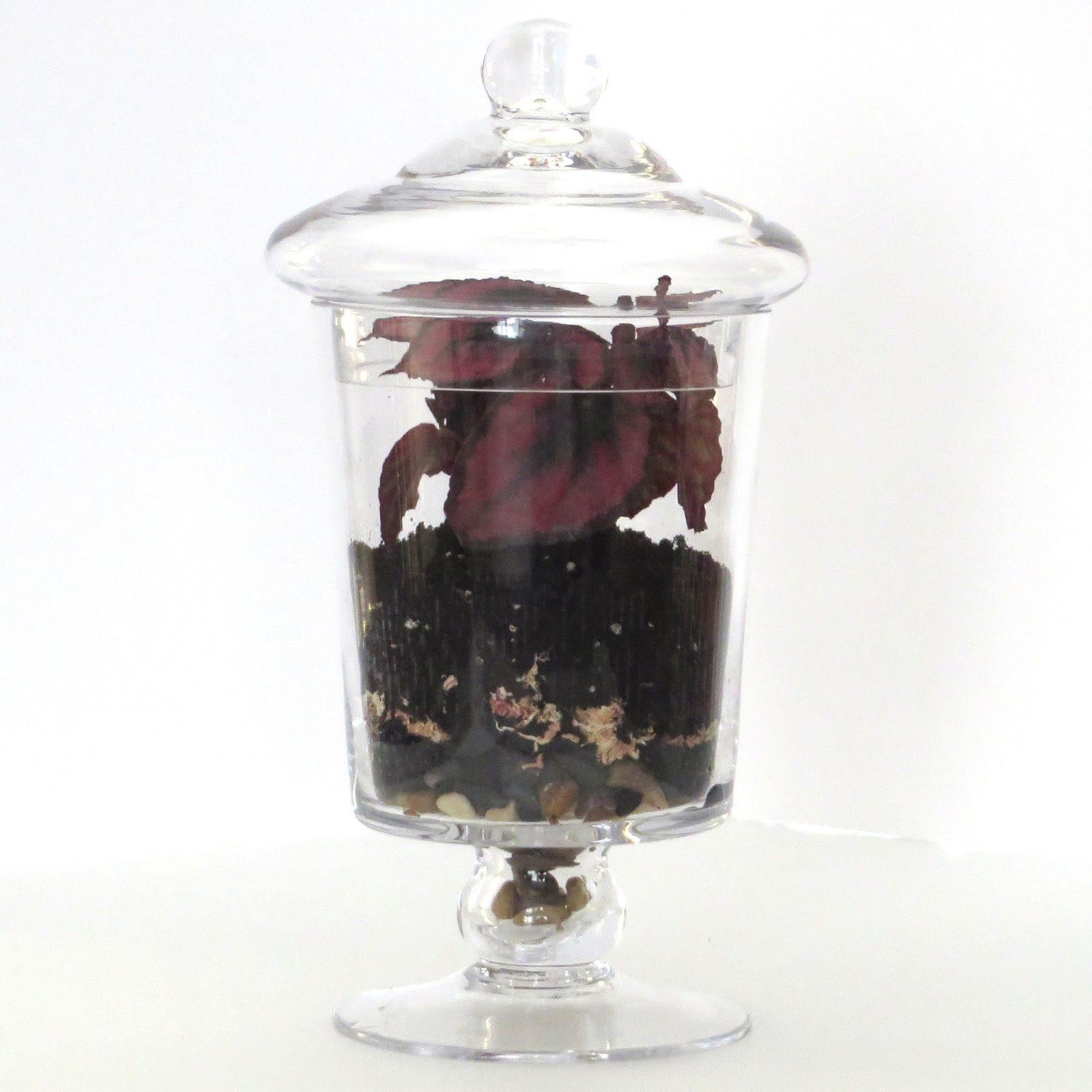
This winter, I got inspired by a really cool looking jar and I decided that a terrarium would be the perfect activity for a cold winter day. It turned out that I was right!
My miniature marvel has inspired me and I am already planning terrarium gifts for a multitude of occasions in the coming year. I’ve been visiting second hand stores for jars and reading up on suitable plants for terrariums.
Creating your own terrarium is a relatively easy task and it’s a great activity for all ages. Here are the basic steps for making a terrarium...
- Start with a clear glass jar that is big enough to hold the layers of planting material and the plants. If you are making a closed terrarium, your jar will need a lid. A wide mouthed jar makes planting easier.
- Place a layer of washed 1/4” decorative stone in the bottom of the jar. Marbles, beach glass or aquarium gravel will also work.
- Then, lay down a thin layer of washed activated charcoal followed by a thin layer of sphagnum moss. The charcoal layer will help to filter the air in the closed environment and the moss will help to prevent the soil from settling down into the stones. Use gloves when handling the sphagnum moss.
- Next, add two to three inches of soil, depending on the size of your jar. Use potting soil that is for indoor plants. If you are planting African violets, use African violet potting soil.
- Place your plants in the terrarium and firmly press the soil around them.
- Add small decorations or accents, if you wish.
- Water lightly and cover with the lid.
A closed terrarium only needs to be watered every few weeks/months. An open terrarium will need watering more frequently. If the soil gets dry, water sparingly. Keep your terrarium out of direct sunlight or it will become a solarium and you’ll bake your plants. Condensation is a necessary part of the water cycle that occurs inside your closed terrarium. If a lot of condensation forms on the inside of the glass, you have over watered and you will need to tip the lid for a day or two to let the excess water evaporate. Remove dead or damaged leaves from your terrarium.
There are lots of options when it comes to choosing plants for your terrarium. African violets, begonias, peperomias and ferns are great choices, but many other types of house plants can also be used in terrariums. Succulents and cacti should only be used in open terrariums.
The Spruce has a great page in their container gardening section called “Getting Started With Terrariums”. It is an excellent resource with lots of ideas and suggestions.
If you get inspired and want to try something different, you may want to have a look at Tovah Martin’s book, The New Terrarium: Creating Beautiful Displays for Plants and Nature. It’s filled with amazing photos, great ideas and lots of excellent information about creating and caring for terrariums.
Making a terrarium is not only a great activity for a cold winter day, your finished miniature marvel is also good for your health. All of the traditional benefits of having plants in your living or work space can also be attributed to your terrarium...stress reduction, improving mental focus and lowering blood pressure. If you're looking for a winter pick-me-up, a terrarium might be just what the doctor ordered. How could enjoying nature inside not be good for you?
It also turns out that terrariums are trendy. Yes, indeed, they are back in a big way and these are not your '70s terrariums. It seems that I'm not the only one who's experienced "Jar"spiration. Terrarium parties and Terrarium Nites are very popular. From millennials to baby boomers and beyond, terrariums are providing an opportunity to be creative with new and interesting materials in new and interesting ways.
You don't, however, have to be on trend to make or enjoy a terrarium. Check your basement, under the kitchen sink or in the back of your closets and cupboards. You've probably got a glass jar somewhere in your home that would make a great terrarium. Get it out and get busy. It's time for you to experience "Jar"spiration and the miniature marvel of your very own terrarium.
🔍To return to the main page, please click on the banner at the top of this page or click on this link: Cupola Corner Blog
There are lots of options when it comes to choosing plants for your terrarium. African violets, begonias, peperomias and ferns are great choices, but many other types of house plants can also be used in terrariums. Succulents and cacti should only be used in open terrariums.
The Spruce has a great page in their container gardening section called “Getting Started With Terrariums”. It is an excellent resource with lots of ideas and suggestions.
Making a terrarium is not only a great activity for a cold winter day, your finished miniature marvel is also good for your health. All of the traditional benefits of having plants in your living or work space can also be attributed to your terrarium...stress reduction, improving mental focus and lowering blood pressure. If you're looking for a winter pick-me-up, a terrarium might be just what the doctor ordered. How could enjoying nature inside not be good for you?
It also turns out that terrariums are trendy. Yes, indeed, they are back in a big way and these are not your '70s terrariums. It seems that I'm not the only one who's experienced "Jar"spiration. Terrarium parties and Terrarium Nites are very popular. From millennials to baby boomers and beyond, terrariums are providing an opportunity to be creative with new and interesting materials in new and interesting ways.
You don't, however, have to be on trend to make or enjoy a terrarium. Check your basement, under the kitchen sink or in the back of your closets and cupboards. You've probably got a glass jar somewhere in your home that would make a great terrarium. Get it out and get busy. It's time for you to experience "Jar"spiration and the miniature marvel of your very own terrarium.
🔍To return to the main page, please click on the banner at the top of this page or click on this link: Cupola Corner Blog
Sunday, January 14, 2018
In a Meadow, We Can Build a Snowman
Bob Eckstein, the author of The History of the Snowman, found evidence of snowmen in the 12th century. Snowmen were very popular in the Middle Ages and Michelangelo was once commissioned to sculpt a snowman. Snowmen have also played a role in both religious and political history. From festivals of old that sought to bring entertainment to the cold of winter to their modern day equivalents, people continue to be intrigued by snowmen.
We are more than likely fascinated by snowpeople because they are, well, like people. Humans like to create effigies. Wikipedia describes snowmen as anthropomorphic. We not only like to build them, we also like to think of them as having human qualities. Throughout the centuries, building a snowman has been a way to create something that celebrates creativity and cold, snowy winters.
I can remember building snowmen as a child and I can remember building snowmen with my daughter. It was lots of fun. These days I usually restrict myself to building miniature snowmen. It’s still lots of fun, and it still gives me the opportunity to be creative out-of-doors during the winter. Snow is like a free art supply...no Michael’s coupon required.
If it’s been years since you built a snowman, it’s been too long. Bundle up and head out to enjoy one of the positive opportunities that winter has to offer. The best days for building snowpeople are when the temperature is hovering near the freezing point. Fresh snow is also helpful. Start small and consider inviting a friend if you want to build larger snowpeople. Snowmen don’t have to be works of art to be appreciated. They can provide entertainment and pleasure just by existing. Snowmen are one of the things about winter that you can love, so get out and get creative! A snowman is waiting for you.
🔍To return to the main page, please click on the banner at the top of this page or click on this link: Cupola Corner Blog
You can purchase Bob Eckstein's book The History of the Snowman on Amazon.
To see a Readers' Digest summary of the book, click here: Readers' Digest
"20 Frosty Facts About Snowmen", by Mental Floss, can be viewed here: Mental Floss
Subscribe to:
Posts (Atom)


![Muddy Boots [Photograph found in She Knows]. (n.d.). Retrieved February 13, 2018, from http://www.sheknows.com/home-and-gardening/articles/972515/update-your-mudroom-for-fall Muddy Boots [Photograph found in She Knows]. (n.d.). Retrieved February 13, 2018, from http://www.sheknows.com/home-and-gardening/articles/972515/update-your-mudroom-for-fall](https://blogger.googleusercontent.com/img/b/R29vZ2xl/AVvXsEjZzGEi1Grumkx3-K-cRhT5Ad52FLzV8E64vTDv_JhJ5ph0J2sHM5NKUL7Zbu7BHAhgb5Rjnlt99C8eEGbHnBVgO_n8BiKvgwenLxDWhxhuKg5d8gBqNpmHlqVE_ydssy9K2WGI9EOP3mEv/s200/Marvelous+Mud+-+Muddy+Boots.jpg)
![O'Keefe, M. T. (n.d.). What Is Adobe? [Photograph found in Photographer's Choice RF Collection, ThoughtCo]. Retrieved February 7, 2018, from https://www.thoughtco.com/what-is-adobe-sustainable-energy-efficient-177943 O'Keefe, M. T. (n.d.). What Is Adobe? [Photograph found in Photographer's Choice RF Collection, ThoughtCo]. Retrieved February 7, 2018, from https://www.thoughtco.com/what-is-adobe-sustainable-energy-efficient-177943](https://blogger.googleusercontent.com/img/b/R29vZ2xl/AVvXsEgrcHAKFvQwcWIQgjGENJE2lrAJvRYRN7zUMgvxb_de9w3sUOnNl14j7EMt4dmH9Z1nF77aCdvJ18c7QK8o_xkKA-UYvAgrI52bjjs5_p7lJTJZyWPjwXvnEcEpn4IcEC1ZY1kzcooldotv/s200/Marvelous+Mud+-+Adobe+Bricks.jpg)
![11 Benefits of Mud Baths [Photograph found in Baths at Roman Spa, California]. (n.d.). Retrieved February 7, 2018, from http://bathsromanspa.com/10-benefits-of-mud-baths/ 11 Benefits of Mud Baths [Photograph found in Baths at Roman Spa, California]. (n.d.). Retrieved February 7, 2018, from http://bathsromanspa.com/10-benefits-of-mud-baths/](https://blogger.googleusercontent.com/img/b/R29vZ2xl/AVvXsEieeXahdnvzFv-TnU4ZyC7yuXlOKwH7rmhxAbi4qHPkmehd9XracBRQQfKCamL8D_dOu6n4IUhhbSf5gXZyRSnJTokhH2qUGQNfoEaWZr1fy_vIw_28qbY82596druGnwTxZ3zEi557pRVS/s200/Marvelous+Mud+-+Mud+Bath.jpg)
![Mud Pie [Photograph found in Food Network]. (n.d.). Retrieved February 13, 2018, from https://www.foodnetwork.com/recipes/food-network-kitchen/mississippi-mud-pie-recipe-2043369 Mud Pie [Photograph found in Food Network]. (n.d.). Retrieved February 13, 2018, from https://www.foodnetwork.com/recipes/food-network-kitchen/mississippi-mud-pie-recipe-2043369](https://blogger.googleusercontent.com/img/b/R29vZ2xl/AVvXsEiLTsS1we4L5WCfRxVPsDOa7sSYyjHp8F4TZfZwvOASEU6sd7haDXHa3oCxqp2puiGlL6DRKTUAmReACFBPJvbPVidgrU4hEdX6Na7o3AQm7s4u05deWfczXPl65awxAi96zZmYZoFqgJ00/s200/Marvelous+Mud+-+Mud+Pie.jpeg)
![Yamatane by Yusuke Asai [Photograph found in Rice Gallery, Houston, Texas]. (n.d.). Retrieved February 7, 2018, from http://www.ricegallery.org/yusuke-asai/ Yamatane by Yusuke Asai [Photograph found in Rice Gallery, Houston, Texas]. (n.d.). Retrieved February 7, 2018, from http://www.ricegallery.org/yusuke-asai/](https://blogger.googleusercontent.com/img/b/R29vZ2xl/AVvXsEhgS90r78wkAz-j5srzoGosp7sLvDjKOJJKXM_oEN_2CBIEoBGY1a-MWDiWdm0nFZcMewFzEbNTfOy06aks3r5dUg7HI4rBOdPAinqtTPT7_AG5PJ5OAWWzUCGG-Na5FU_ohdDxl2dVUxYa/s200/Marvelous+Mud+-+Yusuka+Asai+Mud+Mural.jpg)
![Horned Owl - Mud Glyph Cave [Photograph found in Atlanta]. (n.d.). Retrieved February 7, 2018, from https://www.cnn.com/2013/06/20/us/tennessee-cave-art/index.html Horned Owl - Mud Glyph Cave [Photograph found in Atlanta]. (n.d.). Retrieved February 7, 2018, from https://www.cnn.com/2013/06/20/us/tennessee-cave-art/index.html](https://blogger.googleusercontent.com/img/b/R29vZ2xl/AVvXsEgMWvA0xB1qXZiNF3oYKuXOZuHOg9w3nValFvyKXtCRcJfTcAwa_gx7TQfo506YS28fwq-r8Y6NAgechgLvXdfmlXyEMJ0O6UumBttmJFKfHVhS5cCgcwTmHFAw_ENuxlqFCzSzBWMTtZMt/s200/Marvelous+Mud+-+Mud+Glyph+Cave.jpg)